
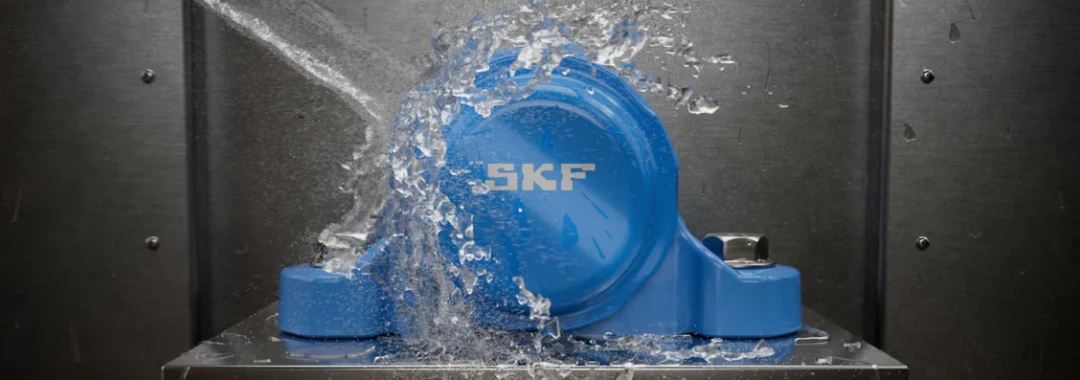
In food and beverage manufacturing, bearing performance is measured not only in hours run, but in hygiene compliance and production uptime. SKF’s Blue Line units are engineered to withstand aggressive cleaning, reduce contamination risk, and support continuous operation.
Food and beverage processing is unforgiving. Production lines often run 24/7, cleaning cycles are frequent and rigorous, and compliance requirements leave little room for error. In this environment, bearings are exposed to far more than rotational load.
“Regular stringent cleaning requirements to eliminate contaminants and reduce bacteria place enormous pressure on manufacturing machinery to keep performing at maximum levels,” says Fabio Rebecchi, Product Manager – Industrial Bearings at Motion.
Frequent washdowns, Cleaning-in-Place (CIP) and Sterilisation-in-Place (SIP) processes, and exposure to caustic antibacterial cleaning agents create a harsh operating environment. Standard bearing units can suffer from corrosion, seal degradation, and lubricant breakdown, leading to premature wear and unplanned downtime.
“Frequent exposure to pressure washdowns and aggressive cleaning chemicals means the bearing unit has to be specifically engineered for that environment,” Rebecchi explains. “It’s not just about load capacity – it’s about how the materials, seals, and lubrication respond to repeated chemical and moisture exposure.”
Designing for compliance
Hygiene compliance adds another layer of complexity. Food processors must meet strict standards around contamination control, traceability, and audit readiness. Components that trap moisture or debris, or that are difficult to clean effectively, can introduce risk.
SKF’s Blue Line bearing units are designed with this reality in mind. The housings are manufactured from food-grade materials and finished in blue to support optical detectability during processing. In the event of component damage, the colour contrast assists with visual identification.
“The blue colour facilitates optical detection during food processing, which reduces the risk of undetectable product contamination,” Rebecchi says.
Material selection is equally critical. Certified food-grade grease compliant with stringent standards such as NSF H1 supports safe operation in the event of incidental contact. For manufacturers supplying multiple markets, additional certifications such as Halal and Kosher provide further assurance.
Reducing maintenance and downtime
Beyond compliance, reliability remains a commercial driver. Unplanned stoppages in continuous processing operations can have significant financial impact, from lost production to wasted product and labour.
One of the key differentiators of the Blue Line range is its sealed, relubrication-free design. By removing the need for routine greasing, the units reduce both maintenance labour and the risk of contamination introduced through manual intervention.
“Maintenance-free products allow the customer to maximise production uptime with the confidence that the product isn’t being contaminated by the maintenance process,” Rebecchi says.
Robust sealing systems further protect internal components from the ingress of moisture and cleaning agents. By preventing contamination from entering the bearing cavity, the design supports extended service life even under frequent washdown conditions.
In practice, this translates to fewer replacements, reduced maintenance frequency and more predictable performance across production cycles.
Supporting performance on site
Motion supports customers by ensuring ready access to the SKF Blue Line range through its national distribution network, enabling faster response for breakdown situations and planned maintenance.
“We are here to improve our customers’ performance,” Rebecchi says. “Our customers’ business isn’t to buy bearings – it’s to make product. If we can help them increase production, reduce downtime, and operate with confidence in a highly regulated environment, then we’ve done our job.”