

Motion and Proco Products help mining customers protect critical fluid handling systems against abrasive slurry, corrosive chemicals, vibration, pressure surges and movement.
Mining fluid handling systems operate in some of the toughest conditions in industry. Slurry transport, tailings management, dewatering, and chemical handling can all expose piping systems to abrasion, corrosion, pressure surges, vibration, and ground movement.
When components fail, the impact is rarely minor. Leaks, backflow, pump stress or pipe damage can create safety risks, environmental exposure, production losses and high maintenance costs, especially at remote mine sites.
For mining operations looking to manage these risks, Motion provides access to Proco Products solutions designed for demanding fluid handling applications.
Managing movement and abrasive slurry
For abrasive slurry and tailings systems, Proco’s rubber expansion joints are designed to absorb movement, vibration and pipe stress. They can help reduce the load transferred from pumps and connected equipment while accommodating movement caused by thermal expansion, installation tolerances or ground settlement.
Proco Products’ Rob Coffee says mining applications often sit in a useful operating range for rubber-based products.
“With mining operations, you have a lot of abrasive slurries and other elements that you have to combat,” he says. “Typically, you’re at the lower temperature ranges where rubber expansion joints or rubber materials work well.”
Different materials and designs can then be selected to match the application. Natural rubber, EPDM and neoprene may suit abrasive slurry duties, while PTFE-lined and moulded PTFE joints are used where strong acids, brines or aggressive chemicals are present.
For higher-solids slurry, filled arch expansion joints can also help by reducing internal turbulence and limiting areas where abrasive material can collect. In longer tailings lines, expansion joints can assist where ground settlement or pipe misalignment becomes an issue over time.
Keeping backflow under control
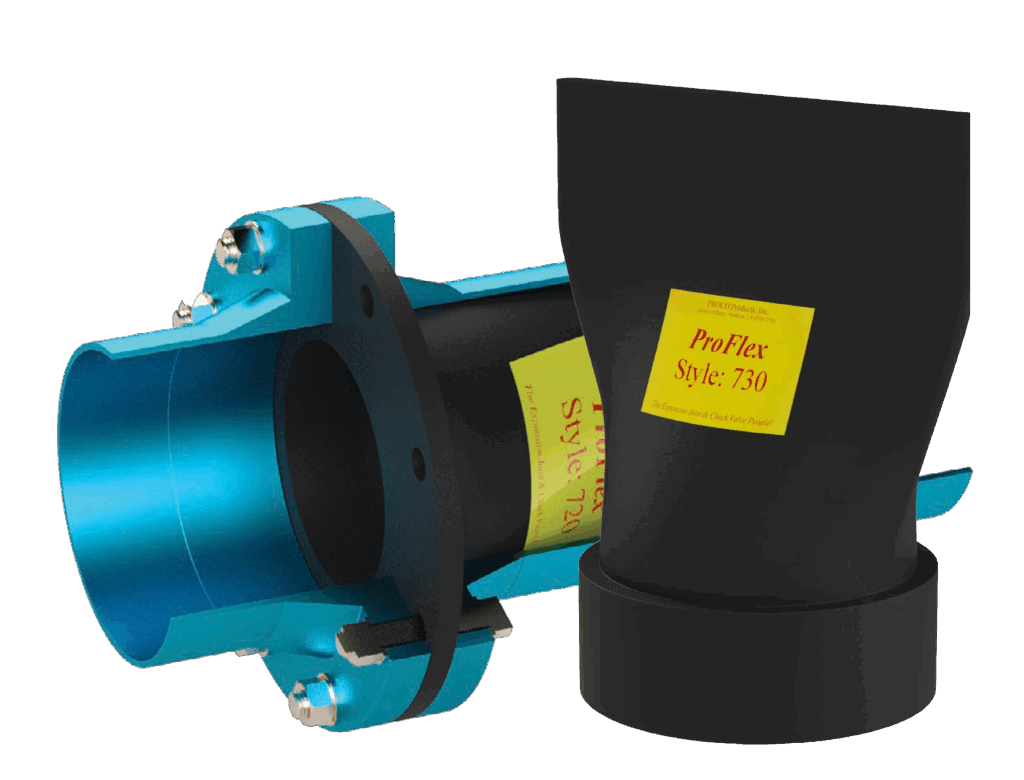
Another key product family is Proco’s ProFlex™ duckbill check valves. Unlike conventional mechanical check valves, these use an all-rubber design with no hinge, flap or mechanical working parts to jam, corrode or seize.
Coffee explains that the valve opens when flow is pumped out and closes under back pressure once the pump stops, preventing reverse flow.
“There’s no mechanical working part,” he says. “As fluid is pumped from one place to a discharge area, like a tailing pond, the valve opens up, and once the pump turns off, it closes, and that back pressure is keeping anything from coming backwards.”
For mining applications, this matters because solids-heavy fluid can interfere with conventional valves. Particles can jam sealing mechanisms, prevent proper closure and create ongoing maintenance issues.
For Motion, Proco adds capability in applications where product quality and reliability carry significant consequences.
“Proco gives us a strong solution in the check valve space, particularly across duckbill and inline pipe check valve applications,” says Phil Austin, National Sales Engineering Manager at Motion. “It has opened up new opportunities for us to support customers with products that are well suited to demanding fluid handling environments.”
The products also have applications outside mining, including stormwater and flood-management systems.
“It’s a real problem solver for councils, particularly where stormwater, flooding and backflow through pipes are a concern,” Austin says.
Looking at reliability before failure
In critical applications, both Austin and Coffee point to the same principle: reliability reduces risk.
For Coffee, environmental protection is closely linked to understanding the condition and expected service life of components before they fail.
“Environmental risk comes back to reliability,” he says. “The issue is understanding where a product is in its life before it fails. Expansion joints are often the forgotten child in a piping system. They sit there doing their job, absorbing movement and stress, so they may not get the same attention as pumps, valves or major mechanical equipment. But when an expansion joint fails, it is typically a big deal.”
That is why Proco places emphasis on inspection, application support and product selection alongside replacement supply.
“When we work with a distributor like Motion, the aim is to help customers look at these components before they become a problem,” Coffee says. “A proper survey, report and recommendation can support the reliability of the plant and help avoid the environmental or personnel issues that can come from a catastrophic failure.”
For New Zealand mining and industrial customers, that combination of specialist product technology and Motion support provides a practical way to manage critical piping components before they become a source of downtime or risk.